
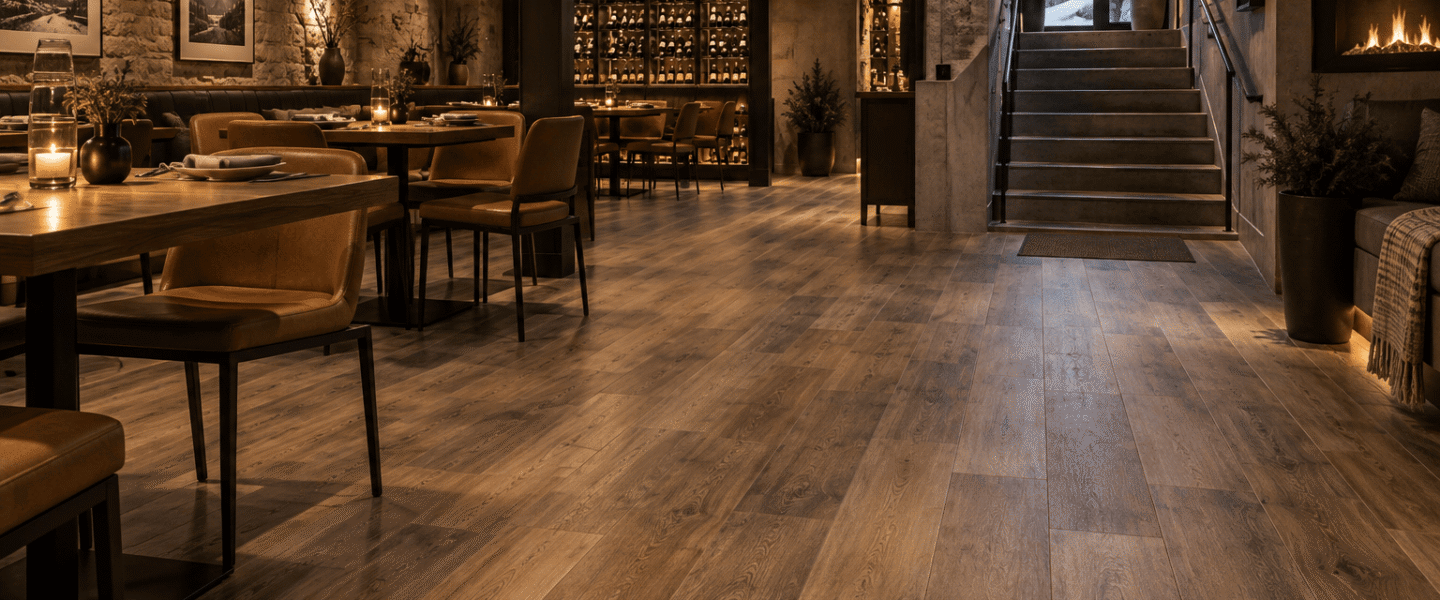
Choosing flooring for a restaurant is already more demanding than choosing flooring for a typical home. Put that restaurant in a basement, and the decision becomes even more important. Proper flooring installation in Calgary needs to account for heavy foot traffic, spills, moisture, concrete subfloors, and the wear that comes with Calgary’s winter conditions.
A Calgary restaurant basement may have a concrete slab, below-grade moisture concerns, heavy foot traffic, food and drink spills, frequent cleaning, and the extra mess that comes with Alberta winters. Snow, slush, road salt, gravel, and wet boots can all make their way inside.
That means the right floor needs to do more than look good, especially in a Calgary restaurant basement where winter snow, slush, road salt, and changing indoor humidity can all affect flooring performance. Depending on the part of the restaurant, options such as vinyl plank flooring, laminate flooring, vinyl glue down, and hardwood flooring can each have advantages for Calgary’s climate and busy commercial spaces.
The best choice depends on how the space will be used, the condition of the concrete underneath, and how much moisture and traffic the floor will face.
Why Restaurant Basement Flooring Needs Extra Planning
Restaurant flooring deals with conditions that most residential floors never experience.
Employees may walk the same route between the kitchen, bar, dining room, and storage area hundreds of times per shift. Chairs move constantly. Tables get shifted during cleaning. Deliveries come through regularly. Spills are part of everyday operation.
A basement adds another layer of considerations.
Moisture From the Concrete Slab
Many Calgary basements have concrete subfloors. Before installing new flooring over concrete, it is important to understand its condition.
Concrete can contain moisture even when the surface looks dry. Excess moisture may cause problems with some flooring products, adhesives, and installation systems.
Depending on the flooring being installed, a contractor may need to assess:
- Moisture levels
- Existing cracks
- Uneven sections
- Old adhesive or flooring
- Low spots
- Surface damage
- Signs of previous water problems
The flooring manufacturer may also have specific requirements for concrete moisture and preparation.
Putting an expensive new floor over a poorly prepared slab can shorten the life of the installation.
Heavy Commercial Foot Traffic
Restaurant floors need to handle much more activity than flooring in an average house.
Typical restaurant traffic can include:
- Customers entering and leaving
- Servers moving quickly between tables
- Chairs sliding across the floor
- Tables being rearranged
- Cleaning equipment
- Food deliveries
- Carts and supplies
- Repeated daily mopping
For this reason, a product that works well in a bedroom may not necessarily be the right product for a restaurant.
When comparing vinyl plank flooring, laminate flooring, vinyl glue down, or hardwood flooring, restaurant owners should look beyond appearance and consider whether the specific product is suitable for commercial use.
Calgary Winters Create Extra Wear
Calgary restaurants also have to deal with seasonal conditions.
During winter, customers can track in:
- Snow
- Slush
- Water
- Gravel
- Dirt
- Road salt
This is especially important for basement restaurants because customers may travel through an entrance, hallway, and stairs before reaching the dining space.
The flooring around entrances and stair landings may therefore face much harsher conditions than flooring farther inside the restaurant.
Good entrance mats help, but the flooring itself should also be selected with moisture, cleaning, and wear in mind.
What Should Restaurant Flooring Be Able to Handle?
Before comparing materials, think about what the floor actually needs to do.
Good restaurant flooring should generally be able to:
- Handle frequent foot traffic
- Be cleaned regularly
- Resist stains and spills
- Work with the existing subfloor
- Provide appropriate traction
- Suit the design of the restaurant
- Handle furniture movement
- Be maintained or repaired when necessary
- Perform well in the specific area where it is installed
The priorities can also change from room to room.
A stylish floor may be ideal for a dining room but inappropriate for a commercial kitchen. The flooring behind a bar may need different features than the floor in a private dining area.
For that reason, one restaurant does not always need one flooring material throughout the entire basement.
Best Flooring Options for a Calgary Restaurant Basement
There are several flooring systems that may work well in a Calgary restaurant, depending on the application.
Here is how some of the most common options compare.
Vinyl Plank Flooring
Vinyl plank flooring is a popular choice for restaurants that want the appearance of wood without using traditional hardwood throughout the space.
Modern vinyl plank products come in a large range of colours, textures, and plank styles. This makes them useful for restaurant interiors ranging from casual cafés to more polished dining rooms.
Potential advantages include:
- Easy day-to-day cleaning
- Good resistance to everyday spills
- Many wood-look designs
- Comfortable appearance for dining spaces
- Commercial-grade products available
- Individual planks may be repairable depending on the system
Vinyl plank can work particularly well in customer-facing areas where design is important.
However, not every vinyl plank product is intended for commercial restaurants. Owners should check the product’s wear layer, commercial rating, warranty, installation requirements, and approved uses.
A residential-grade plank chosen only because it looks good may not perform as well under constant restaurant traffic.
Vinyl Glue Down Flooring
Vinyl glue down flooring is another strong option for busy commercial spaces.
Unlike a floating floor, glue-down vinyl is secured directly to the prepared subfloor with adhesive. This can provide a stable surface in areas with constant foot traffic and furniture movement.
Potential benefits of vinyl glue down include:
- Strong stability
- Suitable options for high-traffic environments
- Low-profile installation
- Wide range of colours and patterns
- Individual damaged sections may sometimes be replaced
- Good option for larger commercial spaces
For a basement restaurant, the installation underneath the flooring is especially important.
The concrete may need:
- Grinding
- Cleaning
- Patching
- Levelling
- Moisture testing
- Primer or another preparation product
Because the flooring is attached directly to the slab, problems with the concrete can affect the finished floor.
The adhesive also needs to be suitable for the specific flooring system and subfloor conditions.
For many restaurants, vinyl glue down flooring can be particularly useful in dining rooms, corridors, service areas, and other busy front-of-house spaces.
Laminate Flooring
Laminate flooring can provide a convincing wood appearance at a different price point than natural hardwood.
It may work well in certain lower-risk parts of a restaurant, particularly areas where appearance is a major consideration and exposure to water is limited.
Potential advantages include:
- Wide variety of wood-look finishes
- Good resistance to everyday scratches depending on product quality
- Easy routine maintenance
- Fast installation with many floating systems
- Consistent appearance across larger rooms
However, moisture deserves extra attention.
Not all laminate products react the same way to water. Some newer products provide improved moisture resistance, but that does not mean every laminate floor is suitable for frequently wet areas.
For that reason, laminate flooring may make more sense in certain dining areas, offices, private rooms, or other spaces where standing water and repeated spills are less likely.
It should generally be selected product by product rather than assuming all laminate performs the same way.
Hardwood Flooring
Few materials create the same atmosphere as real hardwood flooring.
Hardwood can add warmth, character, and a more premium appearance to a dining room. It can work especially well for restaurants with a traditional, upscale, rustic, or natural interior design.
Potential advantages include:
- Natural wood appearance
- Unique grain and character
- Long-lasting visual appeal
- Ability to complement higher-end interiors
- Some hardwood floors can be refinished
At the same time, a restaurant basement can be a challenging environment for hardwood.
Moisture, frequent spills, Calgary’s dry winter air, and changes in indoor humidity should all be considered.
Natural wood expands and contracts as environmental conditions change. That makes correct acclimation and installation particularly important.
Hardwood is also unlikely to be the first option for commercial kitchens, dishwashing areas, or spaces that are regularly wet.
However, it can be an attractive choice for appropriate dining and hospitality areas when the subfloor and environmental conditions allow for it.
Restaurant Basement Flooring Comparison
| Flooring | Moisture Performance | Heavy Traffic | Maintenance | Appearance | Potential Restaurant Use |
|---|---|---|---|---|---|
| Vinyl plank flooring | Good with suitable products | Good to high | Easy | Wood or stone look | Dining rooms, corridors, front-of-house |
| Vinyl glue down | Good with correct system | High | Easy | Wide variety | Busy dining areas, service areas, commercial spaces |
| Laminate flooring | Product-dependent | Moderate to high | Easy | Strong wood look | Drier dining areas, offices, private rooms |
| Hardwood flooring | More sensitive to moisture | Product-dependent | Moderate | Natural premium look | Appropriate dining and hospitality areas |
The exact performance depends on the specific flooring product, installation method, subfloor, and manufacturer’s recommendations.
The Best Flooring May Be Different in Each Part of Your Restaurant
Instead of asking, “What is the best restaurant floor?” it can be more useful to ask, “What is the best floor for each part of this restaurant?”
A Calgary basement restaurant can contain several areas with very different needs.
Dining Room
The dining room needs to balance durability with design.
Restaurant owners often care about:
- Style
- Noise levels
- Comfort
- Easy cleaning
- Chair movement
- Stain resistance
- Long-term appearance
Vinyl plank flooring and vinyl glue down flooring can both work well in many dining environments because they are available in a wide range of designs.
Hardwood flooring may be considered when natural materials are an important part of the restaurant’s design.
Laminate flooring may also suit certain dining spaces if the specific product is approved for the intended commercial use and moisture exposure is controlled.
Commercial Kitchen
A commercial kitchen has very different flooring needs.
The floor may be exposed to:
- Grease
- Food
- Hot liquids
- Water
- Aggressive cleaning
- Heavy equipment
- Constant staff movement
This is not usually the place to choose flooring based primarily on appearance.
Kitchen flooring needs to suit food-service conditions and applicable building, safety, and health requirements.
Specialized commercial flooring systems may be more appropriate than flooring commonly used in dining rooms.
Before selecting a kitchen floor, restaurant owners should confirm what is required for their specific premises and equipment.
Bar Area
Bar floors can experience constant spills and concentrated foot traffic.
Think about:
- Water
- Soft drinks
- Alcohol
- Broken glass
- Bar stools
- Staff standing and walking in a small area
- Frequent cleaning
Moisture resistance and easy maintenance become especially important.
A suitable vinyl glue down product may work well in some customer-facing bar areas, while more specialized flooring may be necessary behind the bar depending on the conditions.
Entrance and Basement Stairs
The entrance deserves special attention in Calgary.
During winter, customers may bring snow and slush onto the floor before reaching the dining room.
Flooring around the entrance should be selected with:
- Wet footwear
- Road salt
- Gravel
- Frequent cleaning
- Slip resistance
- High traffic
in mind.
Even if hardwood flooring is used throughout the main dining area, it may make sense to use another flooring material closer to the restaurant entrance.
Storage Areas
Restaurant storage areas are less about appearance and more about practicality.
Floors may need to handle:
- Heavy shelving
- Boxes
- Carts
- Deliveries
- Cleaning supplies
- Constant movement
A durable commercial flooring system can often make more sense here than a decorative residential-style product.
Check the Concrete Before Choosing Your Flooring
One of the most important parts of installing flooring in a restaurant basement happens before the flooring is even opened.
The concrete needs to be inspected.
A beautiful floor cannot compensate for a poorly prepared subfloor.
Moisture Testing
Basement concrete may look completely dry while still containing moisture.
Moisture conditions can affect:
- Adhesives
- Flooring stability
- Manufacturer warranties
- Long-term performance
The acceptable moisture level depends on the exact flooring and installation system.
For this reason, restaurant owners should avoid relying on one universal moisture number found online.
Follow the flooring and adhesive manufacturer’s specifications instead.
Cracks and Concrete Damage
Small cracks in concrete are common, but they still need to be assessed.
The installer should look for:
- Cracks
- Loose concrete
- High areas
- Low spots
- Previous patching
- Signs of water
- Surface contamination
Some defects can be repaired during flooring preparation. Others may indicate a larger issue that should be addressed before new flooring is installed.
Flatness and Levelling
Flatness is particularly important for vinyl plank flooring, laminate flooring, and vinyl glue down installations.
An uneven subfloor can contribute to:
- Movement underfoot
- Visible unevenness
- Joint stress
- Poor adhesive contact
- Difficult transitions
- Premature flooring problems
Depending on the condition of the slab, preparation may involve grinding, patching, or applying a levelling product.
Existing Flooring and Adhesive
Older restaurant basements sometimes have several generations of flooring.
You may find:
- Old vinyl
- Tile
- Carpet
- Adhesive residue
- Paint
- Coatings
- Previous patches
Removing or installing over these surfaces should not be decided until the existing floor has been inspected.
Floating Flooring vs. Glue-Down Flooring
The installation method can matter almost as much as the flooring material.
Floating Floors
Many vinyl plank flooring and laminate flooring products use click-lock systems.
The planks connect to one another and sit over the subfloor rather than being permanently attached across the entire surface.
Potential benefits include easier installation and the ability to install over certain properly prepared existing surfaces.
However, restaurants should verify that the exact product is approved for the expected commercial traffic and room size.
Expansion requirements, fixed furniture, transitions, and overall floor dimensions may also affect whether a floating system is appropriate.
Glue-Down Floors
With vinyl glue down, the flooring is bonded directly to the prepared substrate.
This approach can offer good stability in heavily used commercial areas.
It can be especially practical where:
- Chairs move constantly
- Large areas need flooring
- Heavy traffic is expected
- Floor height needs to remain low
- Individual sections may need future replacement
However, glue-down installation puts more emphasis on proper subfloor preparation.
An uneven, dusty, damaged, or moisture-affected slab can interfere with the adhesive bond.
Neither installation style is automatically right for every restaurant. The choice should depend on the product, concrete condition, room layout, traffic, and intended use.
How Calgary’s Climate Can Affect Restaurant Flooring
Calgary’s climate should be part of the flooring decision, particularly when natural materials are being considered.
Winter heating can create very dry indoor conditions. At the same time, restaurant entrances can experience significant moisture from snow and slush.
That means two parts of the same restaurant can face almost opposite environmental conditions.
Dry Indoor Air
Dry air can be especially important when considering hardwood flooring.
Wood responds naturally to changes in humidity. Seasonal movement can occur as conditions become drier or more humid.
Correct acclimation and following manufacturer humidity recommendations can help reduce avoidable problems.
Snow and Slush
The area around the restaurant entrance may face repeated moisture exposure throughout winter.
A floor that performs well in a dry dining room may not be the ideal choice directly beside an exterior entrance.
Strategic flooring selection and quality entrance matting can help protect interior floors.
Gravel and Road Salt
Small stones and road debris can scratch or wear some flooring surfaces.
Regular entrance cleaning is important during Calgary winters, especially when customers are walking directly from outdoor sidewalks or parking areas into the restaurant.
Common Flooring Mistakes Restaurant Owners Should Avoid
Choosing a floor based only on colour or price can create expensive problems later.
Common mistakes include:
- Using residential-grade flooring in a high-traffic commercial space. Check whether the specific flooring is designed and warranted for restaurant use.
- Ignoring concrete moisture. Basement conditions should be assessed before the floor is installed.
- Skipping subfloor preparation. An uneven slab can affect the finished flooring even when high-quality materials are used.
- Using one flooring product everywhere. The kitchen, dining room, entrance, bar, and storage areas can have very different needs.
- Ignoring Calgary’s winter conditions. Snow, salt, gravel, and wet footwear increase wear near entrances.
- Assuming all vinyl products perform the same way. Construction, wear layers, commercial ratings, and warranties vary between manufacturers.
- Assuming all laminate is waterproof. Moisture resistance varies considerably between products.
- Choosing hardwood without considering humidity. Seasonal conditions and below-grade installations need to be evaluated carefully.
- Installing over an unresolved water problem. New flooring will not solve active basement moisture or water-entry issues.
- Forgetting about transitions and stairs. These areas should be included in the flooring plan from the beginning.
How to Choose Flooring for Your Calgary Restaurant Basement
If you are comparing vinyl plank flooring, laminate flooring, vinyl glue down, and hardwood flooring, start by answering a few practical questions.
What Happens in This Area?
Is it a dining room, bar, kitchen, storage space, office, hallway, or entrance?
The use of the room should influence the flooring selection.
How Much Moisture Is Expected?
A dry private dining room has different requirements from a bar or food-preparation space.
How Heavy Is the Traffic?
Consider both customers and employees.
A restaurant serving hundreds of people each day needs a floor capable of handling regular commercial use.
What Condition Is the Concrete In?
Look at flatness, cracks, moisture, old adhesives, and previous repairs before selecting the final product.
How Important Is the Design?
For a dining room, the floor can play a major role in creating the atmosphere.
Wood-look vinyl plank flooring, natural hardwood flooring, and modern laminate flooring can all produce very different visual results.
How Much Maintenance Is Practical?
Think about what happens after installation.
Restaurant staff need a floor they can realistically clean and maintain as part of normal operations.
Is the Product Approved for Commercial Use?
Do not assume.
Check:
- Manufacturer specifications
- Commercial rating
- Installation instructions
- Warranty conditions
- Approved locations
This is particularly important when choosing products that are also commonly installed in homes.
What Is the Best Flooring for a Calgary Restaurant Basement?
There is no single flooring material that is automatically best for every restaurant basement.
For many dining and customer-facing areas, vinyl plank flooring can offer a useful balance of design, maintenance, and durability.
Vinyl glue down flooring can be especially practical for busy commercial environments where stability and heavy traffic are major considerations.
Laminate flooring can provide an attractive wood appearance in suitable drier spaces when a commercial-rated product is selected.
Meanwhile, hardwood flooring can create a warm and premium atmosphere in appropriate dining areas, but moisture, humidity, and installation conditions need careful attention.
The best approach is often to choose flooring room by room rather than forcing one material into every part of the restaurant.
Frequently Asked Questions About Restaurant Flooring in Calgary
Can vinyl plank flooring be used in a restaurant?
Yes, some commercial-grade vinyl plank flooring products can be suitable for restaurant dining rooms and other front-of-house areas. Always confirm the product’s commercial rating, warranty, wear specifications, and approved use before installation.
Is vinyl glue down good for restaurants?
Vinyl glue down can work well in high-traffic commercial areas because it is bonded directly to a properly prepared subfloor. Its suitability still depends on the exact product, adhesive, moisture conditions, and intended application.
Can laminate flooring be installed in a restaurant?
Certain commercial-rated laminate flooring products may be appropriate for drier restaurant areas. Because moisture performance varies, laminate should be chosen carefully for spaces where food and drink spills are common.
Is hardwood flooring suitable for a basement restaurant?
Hardwood flooring may work in some dining areas, but basement moisture and Calgary’s seasonal humidity changes need to be considered first. The flooring manufacturer and installer should confirm that the product and installation method are appropriate for the location.
What flooring works best over a concrete restaurant basement floor?
There is no one answer for every concrete slab. Commercial vinyl, glue-down flooring, laminate, hardwood, tile, or other commercial systems may be possible depending on moisture levels, flatness, room use, and manufacturer requirements.
Should restaurant flooring be the same throughout the entire space?
Not necessarily. A restaurant may benefit from different flooring in its dining room, entrance, kitchen, bar, and storage areas because each space faces different levels of moisture, traffic, and cleaning.
Do I need to prepare the concrete before installing new flooring?
In many basement installations, yes. The concrete may require moisture testing, cleaning, patching, grinding, or levelling before the finished floor is installed. Proper preparation helps the flooring system perform as intended.
Plan Your Calgary Restaurant Flooring Around the Space
A restaurant basement puts flooring through demanding conditions. The right choice needs to balance appearance, durability, moisture performance, maintenance, and the condition of the concrete below.
Instead of choosing one material based on appearance alone, compare how vinyl plank flooring, laminate flooring, vinyl glue down, and hardwood flooring will perform in each part of your Calgary restaurant.
A properly assessed subfloor and a flooring product suited to the actual environment can make a major difference in how the finished space looks and performs over time.